
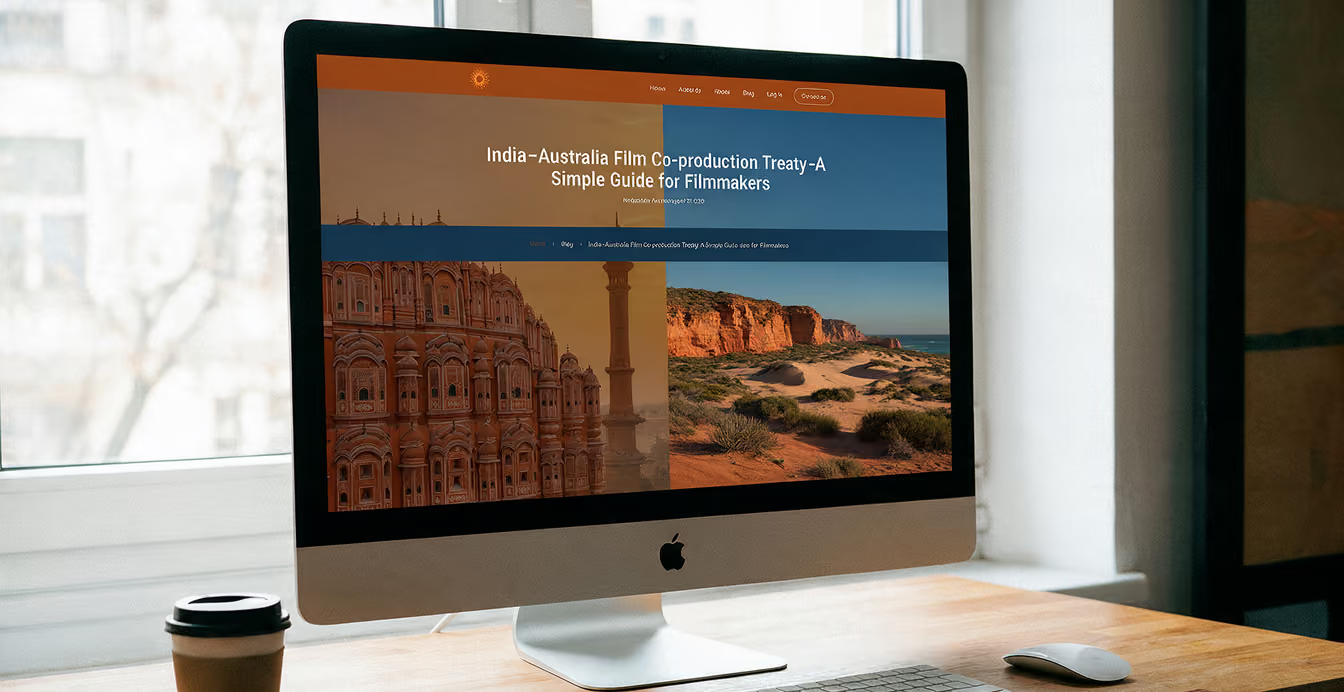
A practical guide for producers, directors and filmmakers in India and Western Australia
WA Indian Film Council | Sources checked 4 September 2026
The India–Australia film co-production treaty provides a framework for eligible Indian and Australian producers to make screen projects together and seek official recognition in both countries. The partners must meet financial, creative and other requirements, and obtain approval from both countries. Official status can open access to relevant support, but does not guarantee funding. Screen Australia’s co-production guidelines
Have a story and a potential collaborator? This guide explains how to explore the partnership, prepare the paperwork and work towards an official co-production.
Where should you start
- If you are based in India: identify a suitable Australian producing partner and check the Indian application pathway through India Cine Hub.
- If you are based in Western Australia: identify a suitable Indian producing partner and discuss eligibility with Screen Australia. Explore Screenwest support separately.
- If you are a writer or director without a producer: consider bringing an experienced producer into the project early to help develop the finance, partnership and applications.
What is the India Australia film co production treaty
The Australia–India Audiovisual Co-production Agreement is an agreement between the two governments. It provides a framework for eligible producers from both countries to make a project together and seek official recognition.
An approved project can be treated as a national production in both countries. This can open access to relevant domestic support, subject to each scheme’s requirements.
The treaty sets the rules. Your producers’ agreement explains how your particular project will work. Both countries must approve official co-production status. Screen Australia: how the program works
Does filming in Perth or India automatically qualify
No. Hiring a local crew, using a location or bringing in an overseas actor does not, by itself, create an official treaty co-production.
International collaboration can also happen outside the official program. The right structure depends on your project.
For example, an Indian production hiring a Perth company to organise a shoot may be a production-services arrangement. A project jointly developed and financed by independent Indian and Australian producers may be suitable for the treaty pathway. Eligibility still needs assessment. Screen Australia: full co-production guidelines
Start with Screen Australia’s program overview, its India partner page, India Cine Hub’s co-production page, and Screenwest’s production funding information.
If you are a writer or director without a producer, a useful first step is to find an experienced producer who can help develop the business and application side alongside your creative work.
How much must each country contribute
Under Article 8 of the treaty, each co-producer must contribute at least 20% of both the finance and the creative contribution. Creative participation must also be reasonably proportionate to the financial contribution.
This means the partnership needs meaningful participation from both sides.
Imagine a fictional project with an AUD $2 million budget:
This is an illustration, not an approved structure. Creative contribution is assessed under the applicable rules; it is not simply a headcount of crew members. Ask the authorities to check your proposed mix of roles and personnel.
Read the treaty through Screen Australia’s India page, particularly Article 8, alongside the co-production guidelines.
How to apply for an India Australia co production
1. Put your idea on one page
Before filling in forms, prepare a short introduction covering:
- The story and intended audience.
- The format: for example, a feature film or series.
- Why an India–Australia collaboration suits the project.
- The people already involved.
- Your approximate budget and development stage.
- The partner or expertise you are looking for.
This is a suggested starting document, not a government application.
Your story does not have to be set equally in both countries. Screen Australia’s guidelines do not require a particular subject or setting. Full guidelines
2. Find a genuine producing partner
Look for someone whose experience, creative approach and working style fit your project.
Ask practical questions: What have they delivered? Who can provide a reference? What can they contribute? Who will manage applications and reporting?
Screen Australia requires the co-producers to be independent, without common management, ownership or control. Opening a related company overseas is not a shortcut to eligibility. Official step-by-step pathway
India Cine Hub’s FAQs also point filmmakers towards information about producers with previous co-production experience.
3. Check eligibility before locking in the project
Together, ask the authorities:
“Does our format qualify, and could this proposed combination of producers, finance, cast, crew and locations meet the treaty?”
Use Screen Australia’s eligibility tool, linked from its provisional approval page, as an initial check. The tool does not replace an official assessment.
Check your specific format with both countries, especially if it is documentary, interactive or otherwise unusual. Filming-permission categories and treaty eligibility are not necessarily the same thing.
4. Agree who brings what
Have a structured discussion about:
- Story and script rights.
- Money each partner will arrange.
- Creative roles and decision-making.
- Where production and post-production will happen.
- Ownership, credits and income.
- What happens if finance falls through or the partners disagree.
Bring in a lawyer experienced in international screen co-productions early. Screen Australia expressly recommends this. Official step-by-step pathway
An introductory MOU can record an intention to collaborate, but it should not be assumed to cover a production’s detailed obligations. Its legal effect depends on its wording. Justice Connect’s plain-language explanation of MOUs is useful background, particularly for not-for-profit facilitators; it is not a film co-production contract template.
5. Organise the paperwork into simple folders
For the Australian provisional application, expect materials such as:
This is an organising aid, not the complete checklist. Use the official provisional assessment guide to check every required attachment.
The Indian producer should separately confirm the Indian requirements through India Cine Hub.
6. Apply early in both countries
The Australian producer applies to Screen Australia. The Indian producer applies through the Indian process. Coordinate the submissions so both describe the same project.
Do not leave this until the cameras are ready.
The Australian assessment guide says to submit when finance is in place and at least six weeks before pre-production. Screen Australia separately publishes an 8–10 week assessment target for complete applications, and approval depends on both countries.
Treat six weeks as a minimum submission requirement, not a guaranteed turnaround. Discuss timing early and allow room for questions and revisions. Application guide, current approval information
7. Plan funding and filming permissions separately
Keep these three questions separate:
Treaty status does not guarantee funding. It may support access to the Australian Producer Offset and other programs, but their additional requirements still apply. Screen Australia: benefits and eligibility
For WA support, check Screenwest’s production funding programs. For filming in India, use India Cine Hub’s guidance and select the appropriate application route.
8. Keep records and obtain final approval
Provisional approval covers the proposed project. Final approval comes after completion.
During production, consult the authorities before making significant changes that could affect eligibility, such as replacing key personnel or changing finance sources. Keep the supporting records organised throughout.
After completion, the producers apply for final approval in both countries. Screen Australia’s resource library includes a final assessment guide. Official pathway
How WAIFC can help filmmakers
WAIFC’s role is to Connect, Facilitate and Advocate. It can help build relationships, facilitate introductions and point filmmakers towards relevant agencies and professional support.
The producers remain responsible for developing, financing and delivering their project. Treaty approval rests with the relevant authorities.
Any agreed acknowledgement of WAIFC’s introduction or facilitation should be documented separately from the producers’ project responsibilities.
Working with First Nations stories and culture
Build appropriate First Nations engagement into development from the beginning. Relevant people and communities need a meaningful role in decisions about their stories and cultural material.
An introduction or advisory conversation does not replace the necessary consultation and permissions. Start with Screen Australia’s Pathways and Protocols: A Filmmaker’s Guide.
Your first week checklist
- Write your one-page project introduction.
- Identify what you need from a producing partner.
- Read the treaty overview and official step-by-step pathway.
- List the eligibility questions you need answered.
- Arrange an initial conversation with an experienced producer.
- Start a shared folder for your project documents.
You do not have to complete the whole process this week. Your first goal is to establish whether the partnership and project are suitable, then build the application with the right people.
This is an introductory educational guide. Check the current official requirements and obtain project-specific legal and accounting advice before committing to a production structure.
Contact WAIFC for introductions and guidance
If you are exploring an India–Western Australia screen collaboration, contact the WA Indian Film Council to discuss introductions and relevant industry pathways. Include a short project summary, your location, your role and the type of producing partner or guidance you are seeking.