

WAIFC INDUSTRY RESEARCH · Published September 2026
Streaming, studios, financing and the changing economics of independent film.
1. The question: is power concentrating in global filmmaking?
The tools of filmmaking are becoming more accessible. But are the economics of reaching audiences becoming more concentrated?
The global screen industry is spending enormous sums on content, audiences have more ways than ever to watch it, and production technology is increasingly accessible. Yet many independent and mid-sized producers report that financing, commissioning, distribution and discoverability feel harder rather than easier. This creates a useful question: is power in global filmmaking becoming concentrated in the hands of a smaller number of studios, streaming platforms and distributors – or is the industry simply moving through another structural transition? This report tests that question against current evidence rather than assuming the answer.
2. Theatrical is recovering – but the old economics have not returned
Theatrical cinema is recovering, but the recovery is uneven and does not restore the old economics. Gower Street estimated 2025 global box office at US$33.55 billion and revised its 2026 projection to US$34.7 billion. That would be growth for a second consecutive year, but still about 13% below the 2017–2019 average at current exchange rates. The important point is that cinema demand has not vanished; the volume and economics of releases have changed.[1]
In the United States, summer 2026 generated about US$4.6 billion, the strongest summer since the pandemic and 26% above the prior summer. Yet the number of wide releases remained below 2019 levels. This is a useful description of the “new normal”: fewer major releases can generate strong aggregate revenue, which rewards scale, marketing reach and eventisation.[2]
That concentration does not mean audiences only want franchises. Gower Street reported that original films helped drive an unusually strong first quarter in 2026, and Reuters’ Cannes coverage highlighted commercially successful lower-budget films and younger audiences responding to horror, comedy, thrillers and distinctive auteur work. The opportunity exists, but discovery and positioning matter more than ever.[3]
3. Streaming has become the centre of gravity – and then became disciplined
The strongest structural change is not that streaming “replaced cinema,” but that streaming became the dominant organiser of screen attention and content investment. Nielsen reported streaming at 48.6% of U.S. TV usage in May 2026, compared with 19.2% for broadcast and 20.4% for cable. This gives platforms a level of audience access and behavioural data that independent distributors cannot replicate.[4]
Ampere Analysis forecasts global content investment of US$255 billion in 2026. Streamers are expected to spend US$101 billion, or around 40% of the global total, after overtaking commercial broadcasters in 2025. Scale and reach are therefore becoming central competitive advantages.[5]

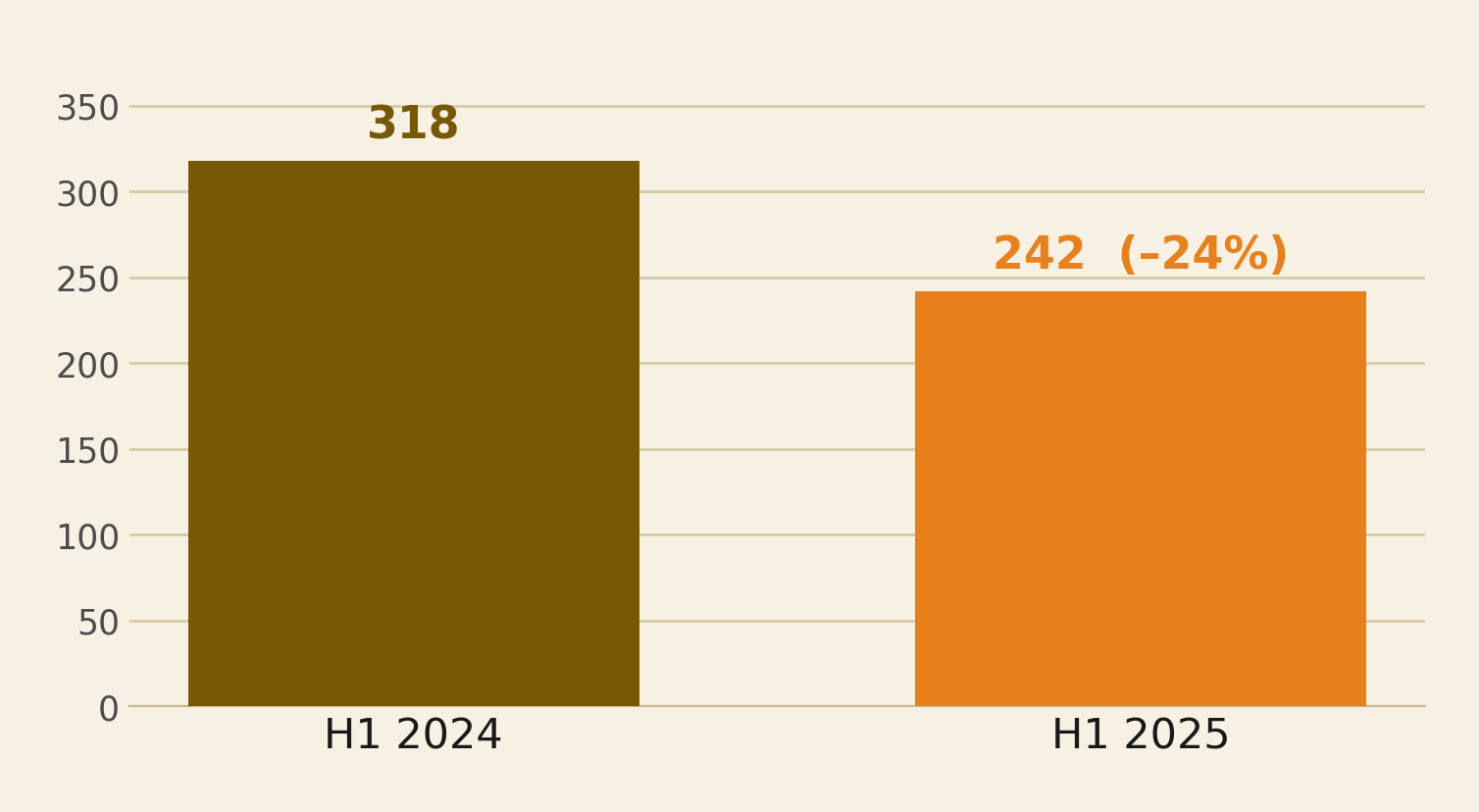
But the “streaming gold rush” phase is over. In the first half of 2025, the top six global streamers reduced scripted original commissions by 24% year-on-year. The major platforms are still spending enormous sums overall, but they are buying more selectively, managing slates more tightly, pushing toward franchises, sports, advertising-supported tiers, proven creators and projects with measurable audience potential.[6]
4. Are the platforms actually making more money?
Some now are which strengthens their bargaining power, but it is not universal. Netflix reported 2025 revenue of US$45.18 billion, up 16%, with operating margin improving by roughly three percentage points. Disney reported US$1.327 billion of Direct-to-Consumer operating income in fiscal 2025, up from US$143 million. Warner Bros. Discovery reported US$1.37 billion of streaming adjusted EBITDA, more than double 2024.[7][8][9]
By contrast, Comcast reported Peacock revenue of US$5.4 billion against US$6.5 billion of costs and expenses in 2025. The market therefore should not be described as “all OTT platforms are highly profitable.” A more accurate conclusion is that the largest services are moving from growth-at-any-cost toward monetisation and margin discipline, and that discipline is being transmitted downstream to producers through fewer commissions, tighter pricing and greater scrutiny of performance.[10]
5. Where independent and mid-sized producers feel the squeeze
Fewer buyers and fewer commissions: Peak TV expanded the number of commissioning opportunities. That cycle has reversed. Ampere found a 24% fall in first-half 2025 scripted streamer commissions, while ProdPro says scripted TV starts fell 7% in 2025 and remain materially below the 2022 peak.[6]
Pre-sales are weaker: Independent producers speaking at the 2025 Screen Summit described pre-sales as exceptionally difficult. Buyers increasingly require clear theatrical potential or a well-defined audience before committing.[11]
Costs rose faster than indie budgets: The BFI identified rising cast, crew and studio costs while independent budgets remained flat or declined in real terms. That reduces recoupment prospects and makes private capital more cautious.[12]
Rights and upside can be transferred to the platform: A streamer buyout can de-risk a film and guarantee a return, but it can also transfer long-term rights and audience upside away from the producer, weakening the ability to build enterprise value from successful IP.[12]
Marketing and discoverability are concentrated: Making a film has become technically easier; reaching a paying audience at scale has not. Platforms and studios control large marketing budgets, recommendation systems, subscriber relationships and global release infrastructure.
Mid-budget ambiguity is punished: A US$10–30 million film often requires meaningful box office, cast and international sales to recoup, while competing with studio marketing and premium streaming. This has made the “middle” particularly hard unless the film has genre clarity, stars, awards potential or strong incentives.
6. The paradox: more production spend, fewer projects
Several markets now show a striking pattern: total expenditure can rise while the number of productions falls. This is critical because headline “record spend” figures can conceal worsening conditions for smaller producers.
7. Independent film is not disappearing – it is bifurcating
The strongest evidence against a simple “indies are finished” story comes from production and market activity. ProdPro reported that independent feature production rose 19% in 2025, concentrated almost entirely in films below US$40 million. Reuters reported record attendance of about 16,000 participants at the 2026 Cannes Marché du Film, where smaller US$10–15 million productions were a major focus because large studios had become more risk-averse.[16][17]
This suggests a bifurcated market. At one end are scaled global franchises, premium IP and platform-backed event content. At the other are contained, distinctive, lower-cost films that can be financed through tax incentives, public funds, co-production, presales, private equity, minimum guarantees and targeted distribution. The most exposed category is often the undifferentiated middle: projects too expensive to survive niche economics, but without enough IP, cast or marketing power to compete as events.
8. Regional signals
United States / global studios
The U.S. remains the centre of global studio power, but even the major companies are under pressure to prove returns. Streaming profitability has improved, linear television is shrinking, and studio groups are pursuing consolidation, bundling and cross-platform monetisation. For producers, this means fewer speculative commissions and more emphasis on defensible IP, audience data and package quality.
United Kingdom and Europe
The UK demonstrates the difference between a successful production-service economy and a healthy domestic independent sector. Record inward-investment production coexists with acute independent finance constraints. Europe remains more supportive of lower- and mid-budget filmmaking because public funding, tax incentives, broadcasters and official co-productions can diversify risk; this is one reason US$10–15 million European-model films were prominent at Cannes 2026.[13][17]
India
India is an especially important counterexample to the idea that OTT simply replaces theatrical. FICCI-EY describes an “AND” market: digital media is expanding rapidly while film theatrical revenues also reached record levels. In 2025 more than 1,900 films were released and film revenue reached INR205 billion, but digital and satellite rights values fell. Producers can no longer assume that an OTT sale will automatically rescue a film’s economics.[15]
Australia
Australia is benefiting from global production and streaming investment, but its domestic ecosystem is similarly concentrated. Screen Australia reports that streaming platforms and broadcasters supplied 73% of investment in Australian TV/VOD drama in 2024/25, while fewer subscription/SVOD titles were made. Screen Currency also explicitly identifies concentration in distribution as a global dynamic that makes it harder for smaller producers to capture the value of the IP they create.[14][18]

9. What the evidence suggests
The Peak TV volume era has ended. Commissioning volume is structurally below the 2021–22 peak, even where spending remains high.
Scale matters more. The biggest platforms combine subscribers, advertising, live sports, data, global rights and marketing. That makes them stronger counterparties.
Theatrical is recovering, but it is more selective. Cinema is not dead; films need a reason to leave home, whether spectacle, horror, comedy, fandom, cultural specificity or event status.
Financing is more layered. Independent producers increasingly need incentives, public funds, co-production, presales, private capital and distribution commitments rather than a single buyer.
Distinctiveness has become a commercial asset. A film that is clearly for somebody can be more financeable than a generic film trying to be for everybody.
Owning IP matters more, not less. Where producers can retain meaningful rights, successful IP can create enterprise value. Full buyouts provide certainty but can cap the producer’s long-term upside.
Data and audience strategy now belong in development. The old sequence, make the film, then think about audience, is increasingly risky. Audience, territory and release pathway affect finance from the beginning.
10. Outlook for independent filmmaking, 2026–2030
The most likely global direction is not total consolidation into a handful of studio films. It is a market in which a handful of scaled distributors control a large share of attention and capital, while production itself remains fragmented and global. Independent films will continue to be made, but sustainable producers will increasingly behave like portfolio managers: controlling budgets, retaining rights where possible, developing repeatable talent relationships, using incentives and co-production strategically, and designing an audience pathway before principal photography.
The strongest opportunities are likely to be in contained genre, culturally specific stories with export potential, prestige films built around festivals and awards, talent-led packages, official co-productions, and projects that exploit a genuine geographic or cultural advantage. AI and virtual production may lower some production costs, but they will not solve the central bottleneck: trusted financing and reliable access to audiences.
For mid-sized companies, the strategic danger is being neither cheap enough nor differentiated enough. The path to resilience is not to imitate studio scale; it is to assemble networks and financing structures that reduce dependence on any single gatekeeper.
11. A two-way opportunity for Western Australia and India
The global evidence also suggests a broader way to think about the Western Australia–India screen relationship. Success should not be measured only by whether a major Indian production relocates studio work to Western Australia. India already has deep production infrastructure, experienced crews, studios, post-production capability and large domestic screen industries. Western Australia’s opportunity is therefore more nuanced: locations, stories, talent, incentives, specialist capability, cultural exchange and projects where a Western Australian partnership creates genuine creative or commercial value.
The corridor should also work in the other direction. Western Australian filmmakers seeking to enter India face a complex ecosystem of languages, industries, rights practices, audiences, financing relationships and distribution networks. WAIFC can create practical value as a connector and market-access intermediary, helping credible producers identify partners, understand pathways, build relationships and develop projects that can operate across both markets. This is not a promise of finance or distribution; it is a role in reducing friction and improving the quality of cross-border collaboration.
12. Conclusion: access may matter more than scale
The evidence does not support the simplistic proposition that a handful of companies now control filmmaking. It does, however, point toward increasing concentration in something arguably more consequential: access. Access to commissioning capital. Access to global audiences. Access to distribution, subscriber relationships, viewing data and marketing at scale.
This may be the defining contradiction of the contemporary screen industry: the tools of filmmaking are becoming more democratised while the economics of reaching audiences are becoming more concentrated. Independent production is not disappearing, but sustainable producers increasingly need sophisticated financing, rights, audience, partnership and international strategies from the development stage onward.
About this publication
This report is published by the West Australian Indian Film Council (WAIFC) as industry research and commentary to encourage informed discussion about changes in global screen financing, commissioning, distribution and market access. It is not financial, investment or legal advice. WAIFC is an industry connector and advocacy organisation; it is not a funding body and does not guarantee finance, distribution, market entry or production outcomes.